
1. Introduction
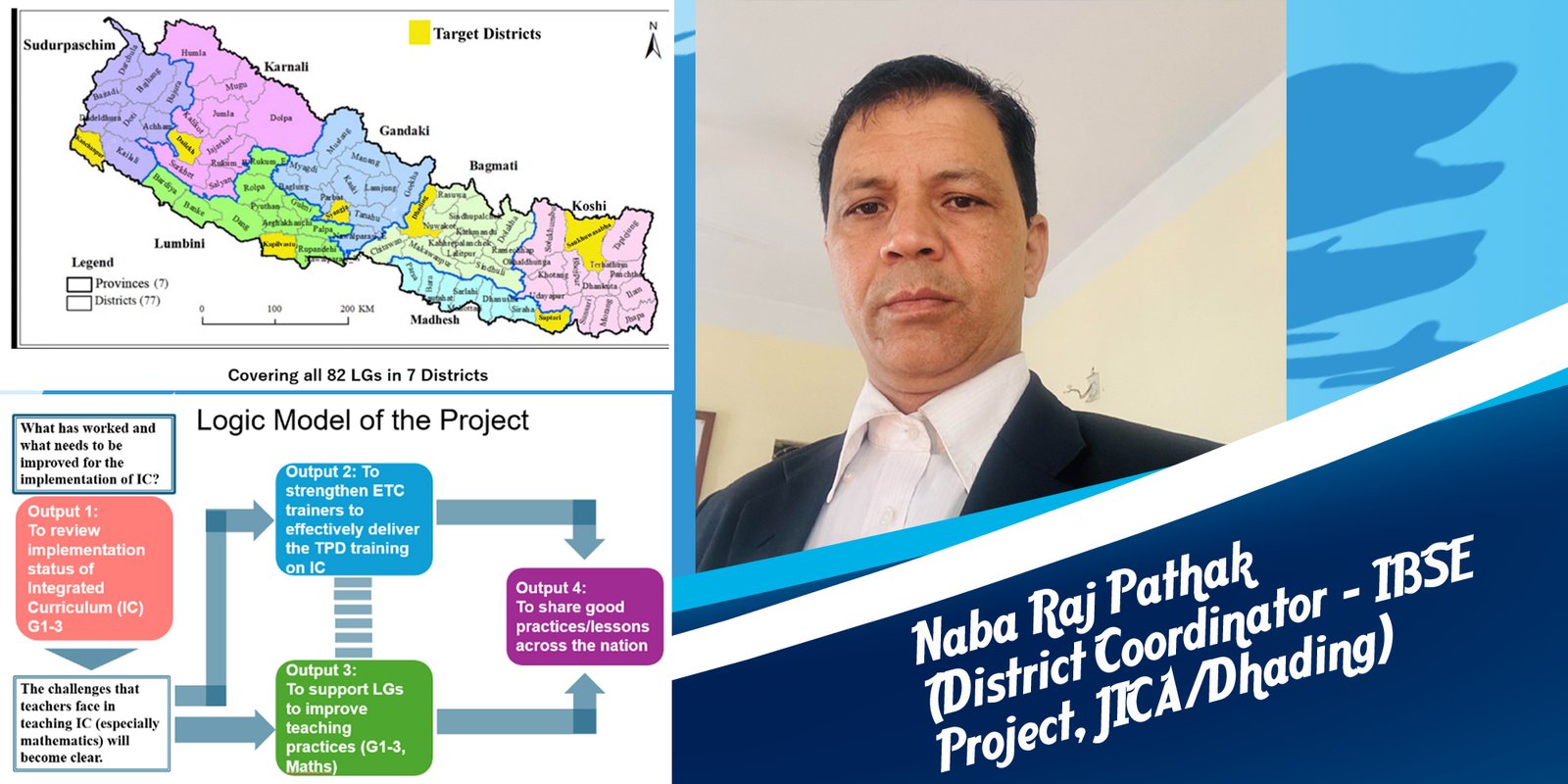
The Project for the Improvement of Basic School Education (IBSE) is being implemented with the support of the Government of Nepal and the Government of Japan. The primary aim of the project is to strengthen the implementation of the mathematics curriculum at the basic level (Grades 1–3) through teacher professional development (TPD) activities. The project is currently being carried out in the Dhading district of Bagamati Province and focuses on enhancing teacher professional development, curriculum implementation, improvements in mathematics education, and lesson observation. The project office is based at the Education Development and Coordination Unit (EDCU), Dhading.


2. Activities Conducted in Dhading District
Baseline Survey (BLS):
In one school from each rural municipality/municipality, baseline data were collected on the status of mathematics learning in Grades 1–3. This included the Mathematics Academic Test, curriculum implementation, teacher capacity development, teaching-learning processes, and student participation. The survey involved head teachers, math teachers, other subject teachers, and Grade 4 students. The initial study also examined the status of mathematics learning, physical infrastructure, and access to educational resources, student engagement, and the practical teaching practice of teachers in selected sample schools across various local governments in Dhading district. The implementation of the Integrated Curriculum (Grades 1–3), introduced under the National Education Policy, was also assessed at the school level.
Coordination with LGs and LEUs:
Regular meetings and coordination were held with the District Coordination Committee (DCC), the Education Development and Coordination Unit (EDCU), and the education sections of all 13 local governments. Brief orientation programs on the project were also conducted.
School Visits, Teacher Interactions, and Lesson Observations:
The implementation of the integrated curriculum was analyzed through school visits, teacher interactions, and classroom lesson observations.
Lesson Study and Lesson Observation:
Collaborative planning, teaching, and reviewing of math lessons for Grades 1–3 were conducted among peer teachers. Observation teams included representatives from the EDCU, LEU officials, teachers, project team members, and Japanese experts. Activities such as lesson planning, co-observation, and joint reflection were carried out collaboratively with teachers. Special emphasis was placed on improving teaching practices in mathematics and integrated subjects through peer learning, pair work, and group learning methods.
Preparation of Orientation Materials (OM) and Videos for Teacher Professional Development:
Reference videos were developed integrating content from Nepali, English, Our Surroundings (Hamro Serophero), and the local curriculum. These videos were piloted in 10 schools, and feedback was collected on teaching methods and practices. Orientation materials based on the “I ExPECT Framework” (IMPACT, EXPLORE, POSITION, EXPAND, COMMIT, TRACK) are being prepared for teacher orientation and training. Short videos demonstrating co-learning strategies—such as Do First, Scaffolding, Pair Work, Counting to Intuition, and Think-Pair-Share (TPS)—as well as the use of experimental and local materials, have been developed to support teachers in facilitation and practical teaching. These videos focus on instructional strategies, sample lessons, classroom management, and effective assessment practices.
Training of Trainers (TOT):
The first phase of the Training of Trainers (TOT) program is being initiated at the EDCU with LEU chiefs and roster trainers to build their capacity to train teachers. In this initial phase, training is being planned for Grade 1–3 mathematics teachers across 29 clusters in six municipalities. In the second phase, training will be extended to 24 clusters across seven municipalities.
3. Conclusion
The IBSE Project in Dhading district is implementing multi-dimensional activities that contribute to enhancing teachers’ practical capacities, promoting active student learning, and encouraging peer learning approaches. The project is expected to significantly improve the quality of education at the basic level. In its initial phase, positive engagement has been observed from teachers, schools, and local authorities. Continued support and guidance are essential to enable teachers to effectively use integrated learning methods and local materials. The training materials and videos show strong potential to lay the foundation for sustained teacher professional development. Additionally, lesson observations, school-level coordination, and regular monitoring are contributing to qualitative improvements in the teaching-learning process.
This project, launched in Dhading in 2024, is scheduled to continue until 2029.
Naba Raj Pathak
(District Coordinator – IBSE Project, JICA/Dhading)
Email: nabaraj.ibse.dhading@gmail.com
Phone: 9849212395